Which safety items can you check in two minutes?
The house's build year against 1978 and 1985, whether every bedroom has a smoke detector and a reasonably sized window, and whether the seller has a radon test result on file. None of these require a tool, just a question or a glance.
| What you see | What it means | Typical cost | Verdict |
|---|---|---|---|
| House built before 1978 | Treat as lead-paint-positive until tested | Test kit a few dollars; remediation $8 - $17/sq ft | note |
| Popcorn ceiling or original floor tile, house built before 1985 | Possible asbestos; don’t disturb it, test it | $30 - $60 DIY kit, $200 - $780 professional | note |
| No radon test result available from the seller | Radon has zero visible signs; testing is the only way to know | $15 - $35 DIY, $100 - $419 professional | note |
| A bedroom with an undersized or missing window | May not meet emergency egress code | Egress window installation varies by scope | walk |
| Missing smoke detector in a bedroom, or no CO detector nearby | Below minimum code in nearly every jurisdiction | $15 - $50 per detector | walk |
Are the bedroom windows large enough to escape from?
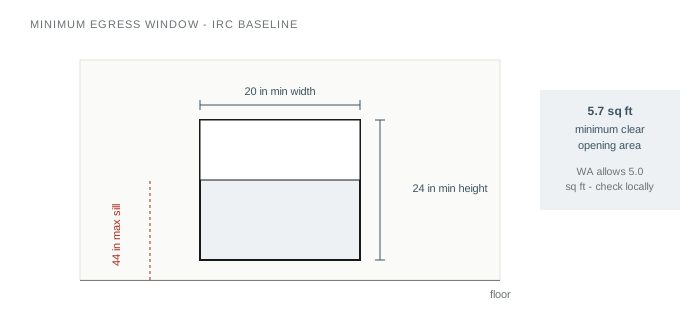
This matters most in finished basements, where a converted bedroom sometimes keeps a small original window instead of adding a proper egress one. Requirements shift slightly by state and city too, Washington allows a smaller 5.0 square foot minimum, for example, so treat the IRC numbers here as a baseline to check against, not a guarantee of what your specific state requires.
How do you identify likely lead paint?
You can't identify it by looking. What you can do is check the house's build year: before 1978 means treat it as likely present, particularly on trim, doors, and windows, the surfaces that get scraped and repainted most often over a home's life.
A test kit costs a few dollars and gives a same-day answer on a specific painted surface. It won't tell you about every layer in the house, but it's a fast, cheap way to move from "probably" to "confirmed" on the surfaces you're most concerned about.
Where does asbestos typically appear in older homes?
Popcorn ceilings installed before the mid-1980s are the most commonly cited example, but it also turns up in vinyl floor tile and its adhesive, pipe insulation, duct wrap, some roof shingles, and joint compound. Homes built before 1978 should be treated as likely positive until tested.
Don't scrape, sand, drill or otherwise disturb any of these materials to check. Intact asbestos is generally low-risk; disturbed asbestos is the actual hazard. If you're planning renovations that would touch any of these materials, that's the point to test, professionally, not with a DIY kit, since accuracy on those is genuinely questionable per multiple sources.
When should you test for radon?
On every house you're seriously considering, regardless of region, age, or how the house looks. Radon has no smell, color, or visible symptom of any kind, which makes it the one item on this entire site that a walkthrough cannot screen for at all.
A DIY kit runs $15 to $35 including lab analysis. If the result comes back at or above the EPA's 4 pCi/L action level, mitigation systems run $800 to $5,000 depending on the type your foundation needs, averaging just over $1,000 for the most common setup.
Questions buyers ask
- What year did lead paint get banned?
- The US banned lead-based residential paint in 1978. Any house built before that year should be treated as likely to contain it somewhere, even if it’s been painted over many times since.
- Is asbestos dangerous if left alone?
- Undisturbed, intact asbestos-containing material is generally considered low-risk, since the danger comes from inhaling disturbed fibers. The real risk shows up during renovation, so it matters most if you’re planning to update anything that might contain it.
- What radon level requires action?
- The EPA sets 4 pCi/L as the action level for mitigation, though it notes that reducing radon even below that level lowers risk further. There’s no way to know a home’s level without testing; it has no smell, color or visible sign.
- How many smoke alarms does a house need?
- At least one in every bedroom, one outside each sleeping area, and one on every story including the basement, plus a carbon monoxide detector within 10 feet of all sleeping rooms. Local codes can require more.
Related checks
Lead paint: EPA.gov (primary source on the RRP Rule and 1978 ban), InspectAndTest. Asbestos: Angi, EnviroPro 360, iBuyer. Radon: EPA / National Radon Program Services, Angi, RadonLocal. Egress and smoke/CO detector code: IRC baseline via Thompson Creek, Window Depot, and municipal code documents. Figures are national averages current as of September 2026; local code requirements vary and should be confirmed with your local building department.