What does the grading around a house tell you?
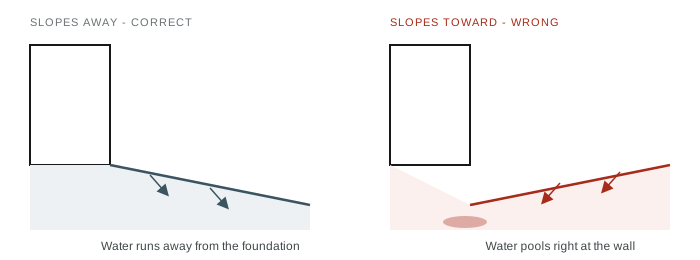
This is worth checking specifically, not just noticing. Bad grading is invisible from inside the house and doesn't show up until the crawl space, basement, or foundation is already affected, at which point you're paying for the water damage, not just the $500 to $3,000 fix that would have prevented it.
How do you assess siding condition from the yard?
Look for cracking, warping, gaps at seams, and soft or spongy spots you can press with a finger. Any of those means moisture is getting behind the surface, which is a different and more expensive problem than surface wear.
| What you see | What it means | Typical cost | Verdict |
|---|---|---|---|
| Ground slopes toward the house instead of away | Water directed at the foundation instead of away from it | $500 - $3,000 to regrade | price |
| Gutters sagging, overflowing or pulling away from the fascia | Water dumping at the foundation instead of through the downspouts | $120 - $900 repair, ~$4,000 full replacement | price |
| Cracked, warped or rotting siding | Moisture behind the surface, worse the longer it sits | $9,000 - $30,000 full replacement, varies by scope | price |
| Peeling paint, especially near the foundation or roofline | Often a moisture symptom, not just a cosmetic issue | Varies with underlying cause | note |
| Large driveway cracks or a sunken slab section | Settling, sometimes tied to the same drainage issue affecting the foundation | $175 - $2,469 depending on material and extent | note |
Which gutter problems cause expensive damage?
Gutters that are sagging, overflowing, or pulling away from the roofline aren't just cosmetic. They mean water is dumping at the foundation instead of being carried away from it, which feeds directly into the grading and drainage problem above.
Check this during or right after rain if you can, or ask when it last rained if you're viewing on a dry day. Overflow at a specific spot, rather than evenly along the whole gutter, usually means a clog or a low point rather than a system-wide failure, which is a much cheaper fix.
Which exterior materials need ongoing maintenance?
Wood siding and trim need the most attention, paint and caulking on a multi-year cycle. Vinyl and fiber cement need far less, which is part of why fiber cement's higher upfront cost, $7 to $18 per square foot versus vinyl's $4 to $12, closes the gap over a 30 to 50 year lifespan.
What driveway and walkway damage matters?
Small surface cracks are routine maintenance. A sunken section, a crack wider than a half inch, or cracking that lines up with a foundation-adjacent drainage problem are worth a second look, since they can share the same root cause as the exterior wall and foundation issues on this page.
Concrete crack repair runs $175 to $650 for routine work, up to $2,400 to $5,400 for resurfacing or releveling a genuinely damaged section. Asphalt is generally cheaper to patch, $100 to $500 for a pothole, but has a shorter overall lifespan than concrete.
Questions buyers ask
- How much does new siding cost?
- Vinyl runs $4 to $12 per square foot installed, roughly $9,000 to $24,000 for a typical home. Fiber cement costs more, $7 to $18 per square foot, but lasts 30 to 50 years versus vinyl’s 20 to 40.
- Does the ground need to slope away from a house?
- Yes, consistently, in every direction around the foundation. Ground that slopes toward the house, even mildly, directs roof and rain runoff straight at the foundation instead of away from it, which is one of the most common preventable causes of basement and crawl space moisture.
- Is peeling paint a sign of a bigger problem?
- Sometimes. Paint failing in a normal, even way across a whole wall is often just age. Paint peeling or bubbling in one specific spot, especially low on a wall or near the roofline, more often points at moisture getting in from somewhere specific.
- What is the lifespan of each siding material?
- Vinyl typically lasts 20 to 40 years and fiber cement 30 to 50 years, with actual life depending heavily on climate exposure and installation quality rather than the material alone.
Related checks
Siding cost figures: Angi, This Old House, The Quick Guys 2026 guides. Gutter costs: Angi, This Old House, EcoWatch, SquareDash. Grading and drainage: Angi, HomeGuide, Lawn Love, Ware Landscaping. Driveway costs: Angi, HomeGuide, Today's Homeowner. Figures are national averages current as of September 2026.