Open the panel door and read the brand name before you check anything else. Federal Pacific Electric ("Stab-Lok" on the breakers) and Zinsco panels are not just old, they're a documented design defect. Independent testing found that up to 60% of FPE Stab-Lok breakers fail to trip during an overload or short circuit, the exact moment a breaker exists to protect the house. A 2005 New Jersey court ruling found FPE had fraudulently labeled the breakers as meeting safety standards. Both brands were commonly installed between 1950 and 1990.
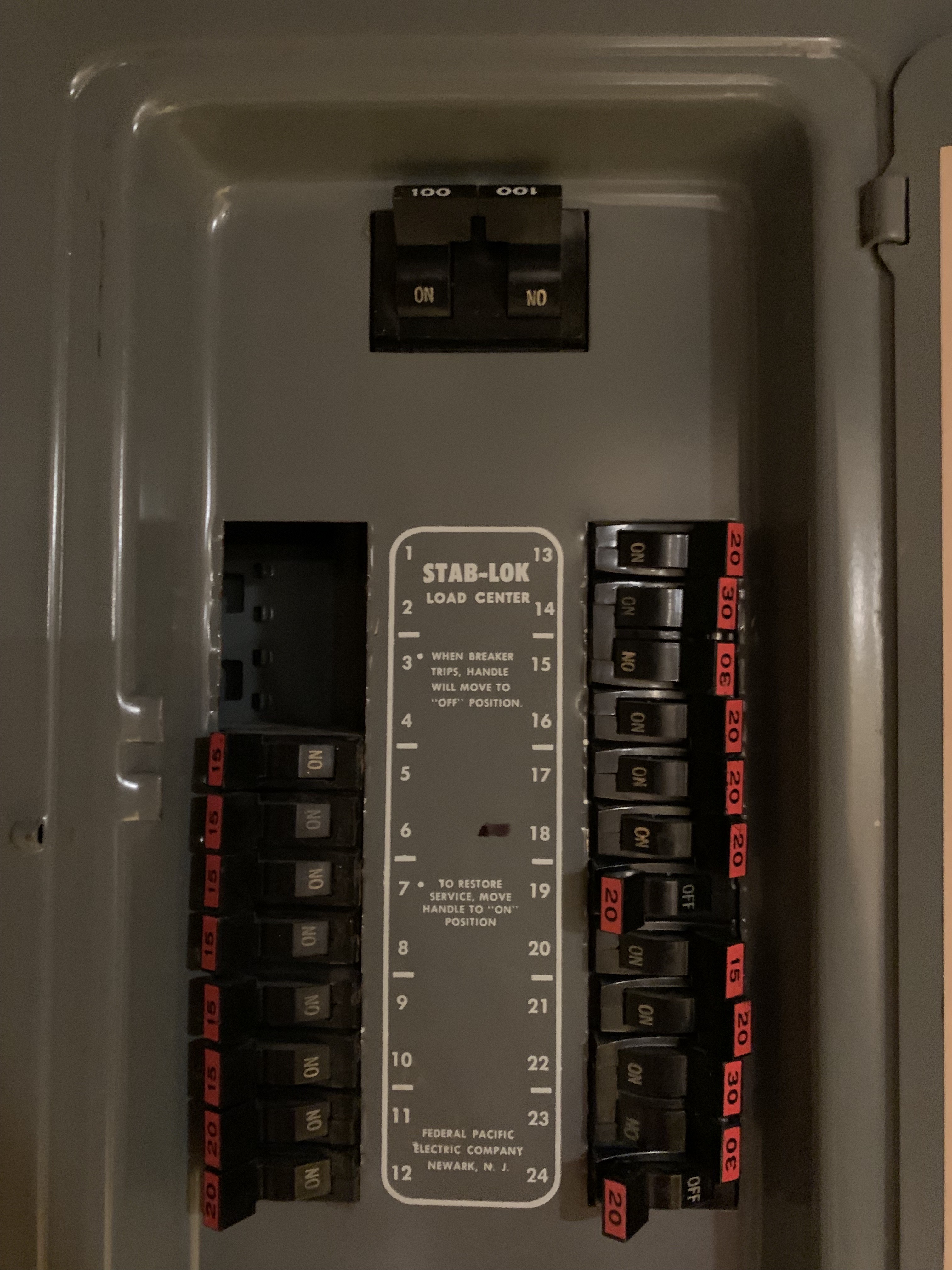
What can you safely check on an electrical panel?
You can safely read the brand name, the amperage rating printed on the main breaker, and look for rust, scorch marks or a burning smell. You should never remove the panel cover or touch anything inside it.
The main breaker, usually the largest switch at the top or center of the panel, has the amperage printed on it, most commonly 60, 100, 150 or 200. That single number tells you a lot about how much the home's electrical service has been updated. From outside the panel, also glance at where the service wires enter the house. Loose connections, trees interfering with the line, or wiring that looks improvised are all things worth mentioning to your agent or inspector even though you can't evaluate them yourself.
Which electrical panels are known safety problems?
Federal Pacific Electric and Zinsco panels are the two to know by name. Both have a documented design flaw that lets circuit breakers fail to trip when they're supposed to, and both were common in homes built between 1950 and 1990.
| What you see | What it means | Typical cost | Verdict |
|---|---|---|---|
| Panel brand reads Federal Pacific Electric or Zinsco | Documented fire hazard; breakers can fail to trip during an overload | $1,200 - $2,500 to replace | walk |
| Rust, scorch marks or a burning smell at the panel | Active overheating or a past incident | Have an electrician evaluate before closing | walk |
| Fuses instead of breakers | Original electrical service, likely 60 amp or less | $1,200 - $4,200 to upgrade to a breaker panel | price |
| Panel is under 100 amps | May not support modern appliance and AC loads | $1,800 - $4,200 to upgrade to 200A | price |
| Cloth-wrapped wiring visible at the panel or in the attic | Likely knob-and-tube, an insurance and safety issue | $3,500 - $9,000 to remove | walk |
| Bare aluminum wiring at outlets or the panel | Higher fire risk at connections; a documented insurance issue | Pigtail fix from ~$1,500, full rewire more | price |
How much electrical service capacity does the house have?
Read the number on the main breaker. Most homes today need at least 100 amps, and 150 to 200 amps is now standard for houses running central air, an electric range or an EV charger.
A panel under 100 amps isn't automatically dangerous, but it's a real capacity limit, not a cosmetic detail. Adding central air, a hot tub or an EV charger to a 60-amp service often means an upgrade regardless of anything else about the house, so it's worth pricing into your plans even if the panel looks otherwise fine.
Which wiring types signal an expensive rewire?
Knob-and-tube wiring (cloth-insulated wire on porcelain knobs, mostly pre-1950) and aluminum branch wiring (common in homes built roughly 1965 to 1973) both cost real money to address, and both can affect whether you can get homeowners insurance at all.
A 2011 US Consumer Product Safety Commission report found homes with aluminum wiring were 55 times more likely to have outlet connections reach fire-hazard conditions than copper-wired homes. That's not a reason to panic over every 1970s house, aluminum wiring can be made safe with the right connectors at a fraction of full rewire cost, but it is a reason to ask directly whether the wiring has been addressed rather than assuming it has.
What must be left to a licensed electrician?
Anything past reading labels from outside the panel. Never remove the panel cover, test outlets inside a wall, or attempt to identify wiring type by pulling back insulation. Those require a licensed electrician, both for your safety and because the assessment holds up in a negotiation.
Questions buyers ask
- How many amps should a house have?
- Most modern homes need at least 100 amps, and 150 to 200 amps is now standard for houses with central air, an electric range, or an EV charger. A panel under 100 amps on a house with modern appliances is a real limitation, not just an old number.
- Is a fuse box a problem when buying a house?
- It signals original, unupgraded electrical service, usually 60 amps or less, which struggles with modern loads and can be hard to insure. It is not automatically dangerous by itself, but it is almost always a near-term upgrade cost.
- Can you get insurance with knob-and-tube wiring?
- Some insurers decline outright, others charge a higher premium, and some require replacement before they will write a policy. Coverage is not guaranteed, which makes this worth confirming with a lender or insurer before waiving your inspection contingency.
- What does rewiring a house cost?
- Removing knob-and-tube wiring runs $3,500 to $9,000. A full copper rewire of an entire house runs $12,000 to $25,000 or more, depending on the home’s size and how accessible the walls are.
Related checks
Panel and rewire cost figures: Angi, ConsumerAffairs, LeadDuo and Caudill's 2026 pricing guides. FPE and Zinsco safety data: Treehouse, Interlock Kit, G4 Electrical, CK Electric, citing IEEE 2012 testing and the 2005 New Jersey court finding against Federal Pacific Electric. Aluminum wiring statistic: 2011 US Consumer Product Safety Commission report, via Honeycomb Insurance and Hippo. Figures are national averages current as of September 2026.