Why do most deck collapses start at the ledger board?
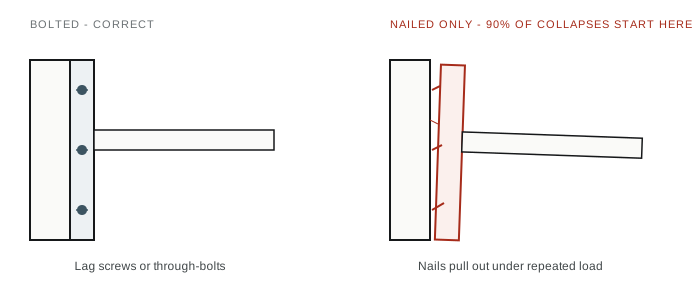
This reframes the whole inspection. You don't need to evaluate an entire deck's structure to catch the highest-risk issue. You need to check one specific board where it meets the house, which takes a couple of minutes if you know to look for it.
How do you check a ledger board without tools?
Look at how it's fastened: bolts or heavy screws are correct, nails alone are not, since nails pull out over time under a deck's repeated load. Then probe the wood gently with a small screwdriver or the wood-rot probe from your toolkit, feeling for soft, spongy give instead of solid resistance.
| What you see | What it means | Typical cost | Verdict |
|---|---|---|---|
| Ledger board attached with nails only, no bolts or screws | The connection point in roughly 90% of deck collapses | Reattachment, varies by scope | walk |
| Ledger board feels soft or spongy when probed | Rot at the exact point that carries the deck’s structural load | Requires professional evaluation | walk |
| A visible gap where the ledger has pulled from the house | The connection is already failing, not just aging | Requires professional evaluation | walk |
| Rusted or loose fasteners elsewhere on the frame | General age or moisture exposure, less urgent than the ledger itself | $10 - $50/sq ft to address | price |
| Visible water staining on the siding above the ledger | Water has been getting behind the ledger connection | See the exterior guide | price |
Also look for a gap where the ledger has visibly separated from the house's siding, rust on the fasteners you can see, and water staining on the siding directly above the connection. Any of these means water has likely been getting into that joint, which is exactly what causes the rot that leads to failure.
What other deck problems are worth checking?
Beyond the ledger: a spongy or bouncy feeling anywhere underfoot, visibly rotted or splintering boards, and rusted or missing fasteners on the railing and stairs. None of these carry the same collapse risk as the ledger, but they're real, boundable repair costs.
What does deck repair or replacement cost?
Repairs run $10 to $50 per square foot depending on scope and material. Full replacement runs $30 to $55 per square foot installed, with whole-project totals commonly landing between $5,000 and $25,000 depending on size and material, pressure-treated wood at the low end, premium composite or hardwood at the top.
Does a patio need the same scrutiny as a deck?
No, not in the same way. A ground-level patio doesn't have a ledger board connection carrying structural load the way an elevated deck does, so the collapse risk this page focuses on mostly doesn't apply. A patio is closer to a driveway in what actually matters: cracking, settling, and drainage, covered on the exterior guide.
Questions buyers ask
- How often should a deck be inspected?
- Annually is the general recommendation, and it’s worth doing your own version of it as a buyer regardless of when the last professional inspection happened.
- Can a deck be repaired instead of replaced?
- Often yes, if the issue is isolated, like a section of rotted boards or loose fasteners. A compromised ledger board connection is the exception, since it’s the structural point the entire deck hangs from.
- Are older decks automatically unsafe?
- No, age alone isn’t the issue, the ledger board connection and general wood condition are. An older deck built and maintained well can be safer than a newer one with a poorly attached ledger.
- What is the lifespan of a wood deck?
- Pressure-treated wood decks typically last 10 to 20 years depending on climate, drainage and maintenance. Composite decking lasts roughly 25 years on average, with premium lines warrantied up to 50, at a higher upfront cost.
Related checks
Ledger board safety statistic and inspection guidance: NADRA (North American Deck and Railing Association), Fine Homebuilding, Inside & Out Property Inspectors. Cost figures: Angi, Thumbtack, HomeGuide, Lawn Love, Premium Decking Supply 2026 guides. Figures are national averages current as of September 2026.