What can you tell about a roof from the ground?
From the sidewalk you can catch missing or curling shingles, moss buildup, a wavy roofline and granule loss collecting in the gutters. What you can't catch is decking rot, which only shows up in the attic or once a shingle is pulled back.
Stand across the street, not right up against the house. That distance is what lets you see the roofline as a single plane instead of a patchwork of close-up shingles. A straight, even line against the sky is what you want. Dips, waves or a visible sag mean the decking or rafters underneath may be rotted or overloaded, and that's a different conversation than a few missing shingles.
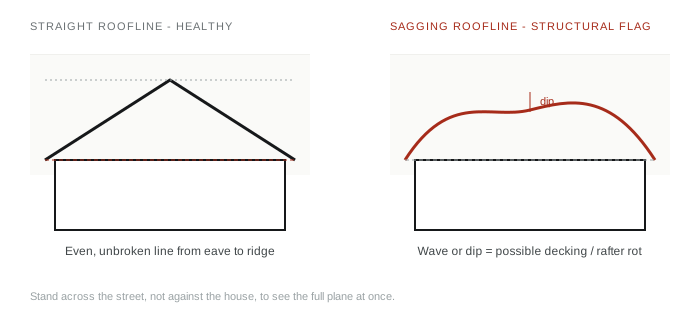
Roughly 40% of roof problems aren't visible from the ground at all, including soft spots in the decking, early-stage leaks, and underlayment that's failing under intact-looking shingles. A clean view from the sidewalk rules out the worst case. It doesn't rule in a healthy roof.
How do you estimate a roof’s remaining life without climbing on it?
Combine the roof's age, if you can find it, with what you can see. Asphalt shingles last 20 to 30 years on average, so a 22-year-old roof with granule loss is close to the end regardless of how it looks, and a 6-year-old roof with a few missing shingles is a repair, not a replacement.
The seller's word on roof age is a starting point, not a fact. The number that actually holds up is the roofing permit filed with the city or county when the work was done. Most municipalities let you search permit history online by address, and it takes less time than the showing itself. If no permit exists for a roof that clearly isn't original, that's worth asking about directly.
Climate shifts the estimate too. Roofs in hot, humid or coastal areas tend to wear out faster than the national average because of UV exposure and moisture. Roofs in areas with heavy freeze-thaw cycles wear down from the other direction. Neither is a reason to panic. Both are a reason to lean on the low end of the 20 to 25 year range instead of the high end when you're doing the math on an offer.
Which roof problems are deal-breakers and which are negotiable?
A sagging roofline is a deal-breaker until a contractor proves otherwise, because it points at structural rot rather than surface wear. Missing shingles, moss and minor flashing damage are negotiable. They cost real money, but they're repairs, not reasons to walk.
The distinction that matters is structural versus cosmetic. A sag, a bounce underfoot in the attic floor, or daylight visible through the roof deck all point at the frame itself, and that's a structural engineer's job to evaluate, not a roofer's. Everything else on this list, missing shingles, granule loss, moss, tired flashing, is a cost to negotiate into the offer, not a reason to drop it.
One more thing worth knowing before you're in a negotiation: more than two layers of shingles is a code violation in most of the country under the International Residential Code, and a few jurisdictions (Oklahoma, for one) require a full tear-off after just a single layer. If you can see a thick, uneven edge at the gable end suggesting multiple layers, that roof needs a full tear-off no matter what condition the top layer is in, and that changes the repair estimate substantially.
What does a roof replacement cost?
A standard asphalt shingle roof runs $3.50 to $5.00 per square foot installed, or roughly $7,000 to $10,000 for an average 2,000 square foot roof. Architectural shingles run $5.55 to $8.95 per square foot, pushing the same roof to $11,000 to $18,000.
| What you see | What it means | Typical cost | Verdict |
|---|---|---|---|
| Missing, cracked or curling shingles | Weather sealing is failing; water gets under the layer below | $200 - $500 to patch | price |
| Heavy granule buildup in the gutters | The shingle’s protective UV layer is gone; roof is nearing the end of its service life | $7,000 - $18,000 to replace | price |
| Wavy or sagging roofline seen from across the street | Decking or rafters may be rotted or overloaded, not just a cosmetic issue | Structural repair, often $10,000+ | walk |
| Moss or dark algae streaks | Trapped moisture accelerating granule loss, usually on the shaded north-facing slope | Cleaning $300 - $600; ignored, feeds into replacement | price |
| Rusted, caulked or tarred flashing at chimney or vents | A prior leak was patched instead of fixed | $400 - $1,600 to redo properly | price |
| A third layer of shingles visible at the roof edge | Code violation in most jurisdictions; full tear-off required before any repair | Forces full replacement, $7,000 - $18,000 | walk |
Labor is 60 to 70% of that total, which is why material grade moves the price less than most buyers expect. A full tear-off and a complex roofline (multiple valleys, dormers, steep pitch) push toward the top of the range or past it. Get two contractor quotes before you use a roof finding to negotiate, not one. Roofers have a well-earned reputation for recommending a full replacement when a repair would do, and a second quote is the cheapest insurance policy in this entire process.
What can a walkthrough not tell you about a roof?
A walkthrough can't tell you the condition of the decking, whether the underlayment is intact under shingles that look fine, or whether a visible repair actually fixed the leak underneath it. Those require an attic look, a drone pass, or a roofer on the surface.
If a roof is old enough or damaged enough to be a real question mark, that's exactly the point where a general home inspector's ground-level look stops being enough. A dedicated roof inspection runs about $252 on average, and a drone inspection, now common and useful for tile or metal roofs a general inspector won't walk on, runs $150 to $400. Either is a fraction of the replacement cost, and both are worth booking during the option period if the roof is a genuine question mark rather than an obvious pass or an obvious replacement.
Questions buyers ask
- How long does a roof last?
- Asphalt shingle roofs last 20 to 30 years, with most homes landing in the 20 to 25 year range. Hot, humid and coastal climates shorten that range; good attic ventilation can add 5 to 10 years back.
- Can you tell a roof’s age from the listing?
- Sometimes, but don’t take a seller’s word for it. The reliable source is the roofing permit on file with the city or county, which records the actual replacement year.
- Is moss on a roof a serious problem?
- Not by itself. Moss traps moisture, which accelerates granule loss over time, but a mossy roof with no other symptoms is a maintenance item, not a deal-breaker on its own.
- Does a new roof lower homeowners insurance?
- Often, yes. Many insurers raise rates or move to actual-cash-value payouts once a roof passes 20 years old, so a recent replacement can qualify a buyer for a better rate.
Related checks
Cost and lifespan figures: HomeGuide, Bill Ragan Roofing and Homewyse 2026 cost guides; This Old House on shingle lifespan; Angi 2026 roof and drone inspection cost data; Insurance.com and SageSure on insurer age thresholds. International Residential Code on shingle layer limits. Figures are national averages current as of September 2026 and will drift with material and labor costs; get a local quote before relying on a specific number.